
From Compliance to Credibility. Why Corporate Social Investment in Romania Needs Better Evidence
Romania has no shortage of corporate social activity. The governance gap is elsewhere: boards often receive strong evidence that money was allocated and activity occurred, but weaker evidence that the intended social outcome was achieved. Credibility requires a traceable chain from capital to intervention, beneficiary, outcome and evidence - and a clearer allocation of responsibility between companies and nonprofit partners.

A market rich in activity, but still short of decision-grade evidence
Romania's corporate social-investment market is becoming more operational. Disability employment, inclusive recruitment, accessibility, NGO partnerships, tax-enabled sponsorship, employee engagement and community programmes increasingly sit inside conversations involving HR, sustainability, corporate affairs, marketing, procurement and finance. The issue is no longer whether companies are active. The more difficult question is whether leadership can see, with sufficient confidence, what those activities produced.
That distinction matters because a corporate budget described as CSR, inclusion, community investment or social impact rarely serves a single objective. In practice, the same expenditure may be expected to support brand visibility, customer loyalty, employer positioning, talent attraction, employee engagement and communications. Those objectives are legitimate. The governance problem begins when visibility is used as a proxy for social value, or when the social objective becomes the least tested part of a programme labelled as impact.
Field experience across corporate-nonprofit partnerships in Romania repeatedly points to the same tension: committed internal champions often protect the social purpose of an initiative, but once a budget is approved the programme may accumulate communication requirements - content, events, employee activation, logo exposure, testimonials and campaign deliverables. A socially relevant intervention can therefore become operationally accountable for everything except the depth and durability of the change it was meant to create.
Visibility can be measured quickly. Social change cannot. The danger is allowing the first to stand in for the second.

The reporting problem: outputs are useful, but they are not outcomes
Most corporate reports can answer the first layer of questions: how much was invested, how many people participated, how many workshops were delivered, how many volunteering hours were recorded, how many beneficiaries were reached. These are valid management data. They demonstrate execution. They do not, by themselves, demonstrate impact.
The second layer is harder and more valuable: whether beneficiaries progressed; whether behaviour changed; whether employment, independence or access improved; whether barriers were removed; whether the change endured; and whether the lived experience of beneficiaries supports the programme's own account of success. In current Filantropì work on social investment, this distinction between quantitative delivery data and qualitative evidence is becoming a central management lens.
For boards, the practical test is straightforward: would the evidence presented at the end of the programme be sufficient to approve the investment again, redesign it, scale it or stop it? If the answer depends mainly on photographs, participation figures and communications reach, the reporting system is describing activity rather than supporting a capital-allocation decision.
The credibility gap is also a control problem
The more sensitive issue is verification. Weak evidence should not be treated as proof of misuse, and it would be irresponsible to generalise allegations of fraud across Romania's nonprofit sector. But the absence of robust verification creates a governance vulnerability: self-reported activity may be insufficient to detect whether resources were used as intended, whether delivery quality matched the proposal, or whether claimed outcomes can be substantiated.
This is where the wider European reporting environment is instructive. The Corporate Sustainability Reporting Directive introduced assurance of sustainability reporting, with the European framework explicitly linking assurance to the credibility and quality of sustainability information. The principle is relevant beyond mandatory reporting: material social claims become more credible when evidence, controls and verification are designed into the system rather than added after the narrative has been written.
For corporate-NGO investment, proportionality matters. A small community grant does not require the control architecture of a major multi-year programme. But larger or higher-risk investments can justify clearer budget traceability, agreed outcome indicators, beneficiary sampling, documentary checks, follow-up measurement and, where appropriate, independent review. The objective is not bureaucracy. It is the ability to distinguish a plausible story from a supportable conclusion.
A distorted bargain: too much accountability is pushed downstream
Romania's corporate-nonprofit market also contains a structural imbalance. Nonprofits are frequently expected to carry almost the entire operating burden of the partnership: understand the social problem, design the intervention, recruit beneficiaries, deliver services, measure results, produce the report, generate stories and images, support employee engagement and satisfy brand requirements.
The problem is not that companies ask for accountability. They should. The problem is that accountability can become asymmetric. An NGO whose survival depends on corporate funding has limited negotiating power when additional visibility, events or communication deliverables are added to the relationship. Over time, the organisation risks behaving less like an independent social partner and more like a low-cost extension of the sponsor's communications machinery.
That dynamic is strategically weak for both sides. It can divert nonprofit capacity away from beneficiaries, obscure the real cost of delivery and incentivise reporting that tells the funder what it wants to hear. A stronger partnership makes the trade explicit: the NGO is accountable for delivery, evidence and stewardship of funds; the company is accountable for realistic scope, proportionate reporting, clear decision rights and communication requirements that do not compromise the intervention.

Disability employment is a test case for the whole market
Disability employment makes the difference between compliance and outcome particularly visible. Romanian employers operate in a regulatory environment in which disability employment obligations and related financial mechanisms can make inclusion a compliance, procurement, HR and social-investment issue at the same time. That can mobilise resources. It does not automatically create employment outcomes.
Awareness sessions, accessibility events, job fairs, recruiter training and NGO partnerships can all be useful. But they remain activities. The outcome questions are different: did candidates with disabilities enter accessible recruitment pathways; were they hired; did they remain employed; were workplace barriers removed; did managers have the capability to support them; did employees gain progression rather than only entry?
This is why inclusive recruitment should be treated as infrastructure rather than campaign activity. The relevant unit of analysis is the pathway - employer readiness, accessible recruitment, candidate capability, workplace adaptation, hiring, retention and progression. The same discipline can be applied to education, employability, social enterprise and community investment: define the change sought first, then determine which activities are necessary to produce it.
Fragmentation is not an administrative inconvenience; it is a strategic constraint
Many companies do not have one social-investment system. They have a collection of programmes. HR owns one initiative, sustainability another, DE&I a third, marketing a campaign, corporate affairs a sponsorship portfolio, procurement a supplier mechanism and a foundation or volunteering platform another set of activities. Each can be defensible in isolation while the enterprise lacks a consolidated view of what the portfolio is building.
Fragmentation makes measurement difficult, but its larger cost is inertia. When social investment is divided across functions, budgets and reporting lines, changing direction requires coordination among stakeholders who may have different incentives and definitions of success. The organisation can continue funding programmes because they are established, visible or internally owned even when evidence about their outcome is limited.
A more credible model therefore starts at the top. The board and executive team do not need to select individual NGOs. They do need to agree the social ambition, portfolio priorities, governance principles, evidence threshold and decision rights. Management can then ask each programme to demonstrate how it contributes to that architecture.
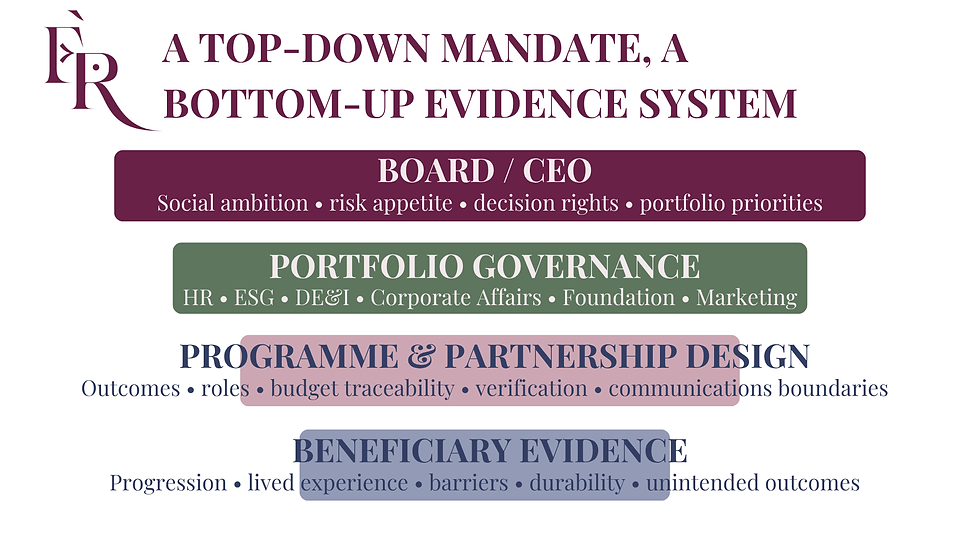
What a credibility architecture would look like
A stronger Romanian model does not require another layer of CSR administration. It requires a small number of disciplines applied consistently across the portfolio:
Define the outcome before approving the activity. The investment case should specify the problem, target group, intervention logic, expected change and evidence that will be used to judge progress.
Separate social outcomes from communication value. Brand and employer-brand benefits can be legitimate objectives, but they should be measured separately rather than used as evidence that the social intervention worked.
Design verification proportionately. The larger, more material or more sensitive the investment, the stronger the traceability and independent challenge should be.
Protect beneficiary evidence. Qualitative evidence and beneficiary voice should complement output data, particularly where progression, behaviour, inclusion or lived experience are central to the intended outcome.
Govern the portfolio, not only the projects. Leadership should be able to compare programmes across HR, ESG, DE&I, corporate affairs, foundations and community investment using a common decision framework.
Make the partnership reciprocal. NGOs should be investment-ready and accountable; companies should be disciplined funders with realistic scope, clear governance and boundaries around communications demands.
The board question that changes the conversation
The most useful question at the end of a social-investment cycle is not whether the programme happened. It is not whether the campaign performed well. It is not even whether the partner delivered every contracted activity.
It is: What changed because we did what we did - for whom, to what depth, for how long, and how confident are we in the evidence?
That question changes the role of impact reporting. Reporting stops being the final communications product and becomes an input into the next investment decision. A company can continue what is demonstrably valuable, strengthen interventions where deeper outcomes are possible, connect fragmented programmes, scale what produces relevant results and stop or reposition investment when the evidence is weak.
Romania already has the capital, corporate champions, nonprofit capability and practical urgency to make this shift. The next phase should not be defined by more activity. It should be defined by better architecture around the activity that already exists: clearer objectives, stronger governance, proportionate verification, beneficiary evidence and executive oversight.
That is the move from compliance to credibility - and it is the point at which corporate social investment becomes decision-grade Social Infrastructure.
THE MANAGEMENT TEST:
What changed, for whom, how do we know - and what should we do next?”
Sources & reference framework
• European Union, Directive (EU) 2022/2464 (CSRD), including provisions on assurance of sustainability reporting.
• European Commission / EUR-Lex, guidance on sustainability reporting assurance under the Accounting Directive and CSRD.
• European Sustainability Reporting Standards (ESRS), revised 2026 framework: material impacts on people and the environment, risks and opportunities, and fair presentation.
• Filantropì Renactimento / ìMedici Institute of Strategic Philanthropy, Social Investment & Social Infrastructure strategic work: quantitative delivery data versus qualitative outcome evidence; portfolio governance; beneficiary voice; decision intelligence.
• Filantropì Renactimento, practitioner observations from corporate-nonprofit, disability inclusion, employability and social-investment work in Romania. These are field observations, not statistical claims about the entire Romanian market.
--
EXPLORE THE SOCIAL INFRASTRUCTURE FRAMEWORK
What are your social investments actually building?
Our Social Infrastructure & Belonging Guide introduces a practical lens for examining how investments in people, communities and partnerships move from activity to lasting organisational and social value.
Use it to reflect on where your organisation is investing, what evidence is being collected, what outcomes those investments are producing, and what leadership should decide next.

--
AUTHOR

Dr. Giulia R. Tufaro is Managing Director of Filantropì Renactimento and Founder of the ìMedici Institute of Strategic Philanthropy.
Her work focuses on Social Infrastructure: the systems, relationships, capabilities and investment structures that enable people to belong, contribute and thrive — while giving organisations stronger evidence for executive decision-making.
She works with corporate leaders, institutions and ecosystem partners to connect investments across philanthropy, talent, inclusion, employee engagement, ESG and community partnerships; assess what those investments are actually building; and translate evidence into decisions about what to continue, scale, redesign or stop.
Her current work explores how Social Infrastructure can become a management discipline — helping organisations move beyond fragmented activity towards measurable outcomes, stronger organisational capability and long-term value.
Connect with her on LinkedIn: https://www.linkedin.com/in/dr-giulia-r-tufaro/
ABOUT FILANTROPÌ RENACTIMENTO
Filantropì Renactimento is a Social Infrastructure advisory and leadership platform working at the intersection of business, people, communities and long-term value.
We help organisations understand what their social investments are actually building. Our work connects initiatives that are often managed separately — across philanthropy, HR, ESG, DEI, Corporate Affairs, volunteering and nonprofit partnerships — and brings them into a common management framework.
--
DISCOVER MORE
For leadership teams that want to examine their own portfolio of social investments, Filantropì Renactimento offers executive diagnostics, strategic advisory and focused working sessions designed to connect evidence with decision-making.
CONTACT
Filantropì Renactimento
Via Ronche di Sopra n. 63, 31046 Oderzo (Treviso), Italy
IT: +39 347 859 8499


Comments