
Italy - From Corporate Philanthropy to Social Infrastructure
Turning fragmented excellence into a shared operating model for talent, territory, philanthropy and measurable business value

Italy does not lack social investment. It has sophisticated foundations, deeply rooted Third Sector organisations, strong territorial institutions, corporate academies, inclusion practices, community partnerships and a long tradition of giving back to place. The more interesting question is what happens when these assets are viewed not as separate initiatives, but as one strategic system.
Across our work in Italy, the recurring opportunity is not to persuade companies to “do more CSR”. It is to help boards and executive teams understand what they are already financing, which business and social objectives those investments serve, where functions are duplicating effort, what outcomes are being created, and where philanthropy can become part of a broader talent and territorial strategy.
That is the emerging conversation around Social Infrastructure: the operating layer that connects people, communities, institutions, employers and social investment - and turns good programmes into repeatable capability.
Italy’s advantage is not activity. It is the density of the ecosystem.
In Italy, a company rarely operates in isolation from its territory. Industrial districts, municipalities, schools, universities, social cooperatives, foundations, associations, vocational providers and families form a dense network around the employer. The Third Sector itself has a defined legal architecture under Legislative Decree 117/2017, with the RUNTS bringing different categories of Enti del Terzo Settore into a more coherent national framework.[1]
This matters because strategic philanthropy in Italy is increasingly less about a cheque and more about choosing the right vehicle, partner, governance model and time horizon. Specialist actors such as Fondo Filantropico Italiano explicitly position philanthropy advisory, donor-advised funds and foundation support as ways to transform giving into structured projects; Vadato operates within a specialised philanthropy advisory model. These are signals of a market moving toward design and governance, not simply generosity.[2][3]
For corporations, however, a second layer is becoming equally important: how philanthropy connects back into the organisation. A community initiative may sit with Corporate Affairs. A skills programme may sit with HR. A foundation may report separately. Employee volunteering may be managed by ESG or Internal Communications. DEI may have its own governance. Marketing may be financing a partnership because it creates visibility. Each programme can be excellent - while the portfolio remains fragmented.
The strategic opportunity is to interpret these investments as one social-infrastructure portfolio: who are we trying to enable, through which mechanism, with which partners, with what role for employees, and with what evidence of change?
“The next phase of Italian corporate social investment is not necessarily more programmes. It is better architecture around the programmes companies already have.”
The CSR budget is rarely only a social-impact budget
One of the most important lessons from our conversations with both corporations and nonprofit organisations in Italy is that corporate–Third Sector partnerships are often misunderstood from both sides. An ETS may understandably approach a company with the social need first. The company, however, is usually constructing the budget against several internal objectives at once.
A partnership can create territorial impact and still be expected to support brand awareness, employee engagement, employer branding, client relationships, sales activation, leadership development or stakeholder trust. In some organisations, several budget owners may need to see value before an initiative moves forward. That does not make the partnership less authentic. It makes the operating model more complex.
This is also why corporate fundraising capability matters for nonprofits. The strongest proposal is not simply “our cause deserves funding”. It shows that the organisation understands the corporate strategy, can design a credible activation, can protect beneficiary dignity, can report transparently, and can translate a social intervention into a partnership architecture that different internal functions can understand.
For companies, the mirror image is equally important: a partnership should not be judged only by visibility or the size of the donation. The executive questions are broader. Was the partner appropriate? Did the initiative reach the intended community? Did employees engage? Did it strengthen access to skills or employment? Did the intervention create a credible outcome? Can the company explain why this programme belongs in its portfolio?
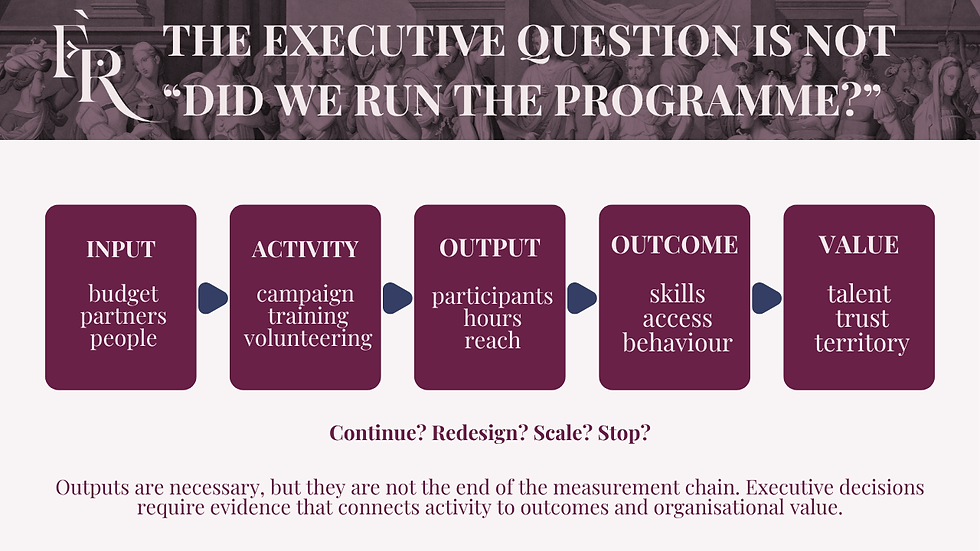
From reporting activity to understanding outcome
This distinction becomes especially relevant as Italian subsidiaries of multinational groups work inside increasingly mature ESG architectures. In many of the companies we speak with, the high-level sustainability framework is already defined at Group level. Local teams are not starting with a blank sheet. Their challenge is to interpret global priorities in the Italian context, select credible local initiatives, collect useful evidence and contribute to reporting without reducing social investment to a catalogue of activities.
That creates a practical role for stronger CSR and social-impact reporting. A programme can report 500 participants, 2,000 volunteer hours or 20 workshops and still leave the central question unanswered: what changed? Participation is an output. A new skill, an employment transition, increased access, changed behaviour, strengthened organisational capability or sustained community benefit is an outcome.
The difference sounds technical, but it changes capital allocation. Once an organisation can distinguish input, activity, output, outcome and longer-term value, it can make better decisions about whether to continue, redesign, scale or stop a programme. This is the logic behind our Social Infrastructure Assessment™ and the ìMedici C-Suite Briefing™: one programme, one investment and one executive decision - supported by evidence rather than by momentum.
Italy already shows what social infrastructure looks like when it is rooted in territory
The phrase “social infrastructure” can sound abstract until it is experienced in everyday life. My own understanding of inclusion was formed in Italy long before I began using this language professionally. I went to school in an environment where a classmate with Down syndrome could be part of the same class, with dedicated support and an education system adapted around inclusion. I saw families supported by local services and rehabilitation structures. I saw employment services with specific pathways for people with disabilities. I encountered people with disabilities in public-facing roles and later in workplace environments.
What was striking was not one heroic programme. It was continuity. The school, municipality, health system, employment service, family and employer each carried part of the infrastructure. Italy’s inclusive-education model reflects this philosophy at system level: learners with disabilities overwhelmingly attend mainstream education, with support teachers, individualised planning and responsibilities that extend across schools and local authorities.[4]

This territorial dimension is an important Italian strength. But it also creates a question for the next phase: can employers participate more intentionally in the infrastructure rather than simply benefit from it? A company can fund a local project, but it can also create apprenticeships, offer mentoring, engage employees as skilled volunteers, strengthen inclusive recruitment, involve suppliers and work with universities or municipalities to build a longer talent pipeline.
In other words, the territory should not be seen only as the beneficiary of corporate social investment. It can become part of the workforce strategy.
Disability employment: from legal obligation to talent pathway
Italy also has a strong legal foundation for disability employment. Law 68/1999 establishes reserved employment quotas for public and private employers: 7% of the workforce for employers with more than 50 employees, two workers for employers with 36–50 employees, and one worker for employers with 15–35 employees.[5] The law is built around “collocamento mirato” - targeted placement - which is more sophisticated in principle than a pure quota mechanism because it is intended to match people, capabilities and roles.
Yet compliance does not automatically create a talent pathway. The strategic question is whether organisations can move from fulfilling an obligation to building an accessible recruitment and development system: candidate sourcing, role design, manager capability, accommodation, mentoring, progression and retention.
This is where we see a strong case for adapting AccessForward to the Italian market. The programme has been designed as a multi-company talent accelerator for people with disabilities, connecting employers with specialist recruitment and inclusion partners. In Italy, it can sit alongside the existing legal and territorial infrastructure rather than replicate it: helping companies translate collocamento mirato into a more deliberate white-collar talent strategy, with measurable hiring outcomes and a stronger candidate experience.
The opportunity is particularly relevant for organisations that already have mature inclusion policies but want to create a more repeatable pipeline into professional, technical and corporate roles. AccessForward is not positioned as an awareness campaign. Its value is in conversion: from stated intent to candidate access, capability-building, employer readiness and hires.
Good practice is already visible — and often sits at the intersection of talent and territory
Several Italian programmes illustrate why this intersection matters. UniCredit’s social strategy combines foundation activity, education, community investment and employee volunteering; in 2025 the Group reported approximately €71 million in social contribution and more than 15,000 employee-volunteering hours, while its Foundation has developed a more structured, community-centric approach to educational poverty.[6][7] Its “ilMioDono” platform also connects nonprofit organisations with donors, showing how a corporate platform can strengthen Third Sector fundraising capacity rather than simply fund one organisation.[8]
HModa offers another useful model. Its Accademia HModa links vocational education directly to the skills needs of Italian fashion districts; in 2025 it planned multiple training paths across regions and reported strong employment conversion from its programmes. Its ESG Academy similarly treats sustainability capability as something that must reach operational roles across the value chain.[9] This is social infrastructure in a very practical form: training is connected to industrial continuity, territorial skills and employment.
Golden Goose’s Academy combines craftsmanship, creativity and community. Its One Year Dream Maker programme has included a partnership with Mygrants to support people with migrant backgrounds toward labour-market access, while its community work with Fondazione TOG connects product design, rehabilitation expertise and the company’s own Academy.[10][11] The value of these programmes is not that every company should imitate them. It is that they show how social investment can be designed around capabilities that are already native to the business.
Accenture’s corporate-citizenship approach makes a similar connection between nonprofit partnerships, career pathways, pro-bono support and employee mentoring; IBM’s social-impact portfolio explicitly includes skills programmes, community support and volunteering targets.[12][13] In different sectors, the common pattern is visible: the strongest social programmes are rarely detached from people, skills, technology, culture or the organisation’s own operating strengths.
The missing layer: employee agency and skilled volunteering
One area that deserves much more attention in Italy is employee involvement. Corporate volunteering is often treated as an engagement activity - useful, positive and visible - but its strategic potential is much greater. Employees carry expertise, professional networks, local knowledge and credibility. When structured well, volunteering can support nonprofit capability, mentoring, education, employability, digital skills and community resilience.
The next evolution should also give employees a stronger voice in identifying territorial needs. Many companies operate across several Italian regions, each with different labour-market and social priorities. Internal platforms or giving councils can allow employees to surface community needs, propose partners, participate in selection and contribute expertise. That transforms philanthropy from an external programme into a mechanism of belonging and shared responsibility.
There is a governance benefit as well. Employee participation can help a company understand whether its social-investment priorities feel relevant to the people closest to the territory. It can create a feedback loop between headquarters, local sites and communities - provided the company still applies due diligence, clear criteria and outcome measurement.
“The employee should not be only a volunteer invited to one day of activity. The employee can be a sensor, mentor, expert and co-designer of the company’s relationship with its territory.”
DEI in Italy can now broaden from protected categories to belonging infrastructure
Italy has made important progress in how organisations interpret diversity, equity and inclusion. For many years, corporate attention was heavily concentrated on gender equality and disability, both essential areas that remain unfinished. The next phase can broaden the lens without weakening those priorities.
Neurodiversity, intergenerational inclusion, socioeconomic background, migration, caregiving, psychological safety and belonging increasingly shape workforce experience. The practical implication is that DEI cannot sit only in policy, awareness months or observatories. It needs to connect with recruitment, management capability, workplace design, learning, data and the social investments companies make outside their walls.
This is also why universities, research centres and specialised observatories matter. Italy has strong academic and institutional capacity to improve measurement, study inclusion and test better models. For our work, collaboration with universities, research centres, specialists in philanthropy and fiscal structures, and Third Sector actors is not an accessory. It is part of building a national ecosystem capable of translating evidence into practice.
Strategic philanthropy also needs an operating model
The Italian market is particularly ready for a more mature conversation about philanthropic structures. Companies are asking when a corporate foundation is appropriate, how it should be governed, what should remain inside the company, how a foundation relates to ESG and Corporate Affairs, how social investment should be financed, and how partnerships with ETS should be selected and monitored.
Foundation creation is therefore not simply a legal incorporation exercise. It is an operating-model decision. Purpose, governance, board composition, decision rights, funding, grant-making processes, conflict-of-interest rules, reporting, impact measurement, communications and the relationship with the corporate brand all need to be designed together.
Our national strategic partnerships with Vadato and Fondo Filantropico Italiano strengthen this work by bringing specialised philanthropy expertise into a wider social-infrastructure approach. Depending on the corporate need, the solution may be a foundation, a philanthropic fund, a structured partnership portfolio or another vehicle altogether. The point is not to create an institution because it looks mature. The point is to choose the structure that best serves the strategy.
Why companies are asking for smaller rooms, not only larger conferences
A second signal from the Italian market is the demand for curated executive spaces. Companies do not only want another conference at which sustainability is discussed in general terms. They increasingly value smaller laboratories, roundtables and forums where HR, Sustainability, Corporate Affairs, foundations, DEI leaders, universities and specialist partners can work on the same question.
That is why we are building two complementary platforms in Milan in 2027. The Talent & Purpose Strategy Lab, on 25 March 2027, is designed as an invite-only working environment around the connection between social investment, talent infrastructure and workforce strategy. Rather than treating purpose as communications, the Lab asks how companies can use philanthropy, inclusion, community partnerships and employee engagement to strengthen attraction, development, belonging and retention.
The Corporate Social Infrastructure Forum - “Filantropia come Strategia” - on 20 May 2027 moves the discussion outward: from individual programmes to governance, partnerships, territorial value, impact evidence and the infrastructure that connects business with the communities in which it operates. The Forum is intended to involve corporations alongside universities, research centres, specialised philanthropy partners, Third Sector organisations and experts in areas such as governance and fiscal structures.
These platforms are also deliberately commercial in a transparent way. Organisations that want to contribute thought leadership, sponsor the conversation or position relevant services in front of an executive audience can discuss partnership options with us. The objective is not to sell speaking slots as visibility. It is to build a curated ecosystem around a strategic problem.
Explore sponsorship, partnership and participation opportunities: contact Filantropì Renactimento
The board-level question: can we see the whole portfolio?
For CEOs and boards, social infrastructure offers a different governance lens. Instead of reviewing programmes by department, leadership can ask what the organisation is collectively investing in people and communities - across philanthropy, foundation activity, DEI, volunteering, education, employability, community partnerships and selected social elements of ESG.
That portfolio view can reveal concentration and gaps. A company may be heavily invested in education but have no conversion into internships or jobs. It may have strong external philanthropy but little employee participation. It may sponsor many local organisations without a shared measurement framework. It may have a global DEI strategy but weak local talent pathways. None of these are necessarily failures. They are signals that a cross-functional operating model could unlock more value from the same investment.
A useful executive review therefore starts with a small number of questions: What problem are we solving? Who owns the outcome? Which functions benefit? What role do employees play? Which partners are critical? What is the evidence beyond participation? What does the territory gain? What does the organisation learn? And what decision will we make when the evidence arrives?
This is where the C-Suite Briefing becomes practical. The purpose is not to create another 80-page strategy. It is to bring one programme or one investment into the room, examine it through a social-infrastructure lens, and support leadership in making a decision: continue, redesign, scale or stop.
Italy does not need to invent social infrastructure. It needs to make it visible.
Perhaps the most important conclusion is that Italy already contains many of the ingredients. It has territorial institutions, a sophisticated Third Sector, corporate foundations, social cooperatives, inclusive schools, employment mechanisms, universities, research capacity, industrial districts and companies with long-term community programmes. The opportunity is to connect those assets more intentionally.
For companies, that means seeing philanthropy not as an isolated act of generosity but as part of the architecture through which the organisation develops talent, earns trust, strengthens territory and learns from society. For nonprofits, it means becoming more capable corporate partners - able to understand business objectives without compromising mission. For ESG and sustainability leaders, it means moving beyond output-heavy reporting toward evidence that can support decisions. For HR, it means recognising that some of the most important talent infrastructure may sit beyond the traditional boundaries of HR.
And for boards, it means asking a more ambitious question: not simply how much did we give, how many people participated or how many projects did we run - but what capability did we build, for whom, and can we reproduce it?
“When philanthropy, talent, inclusion and territory are governed as one system, social investment stops being peripheral. It becomes infrastructure.”
A practical Social Infrastructure agenda for Italian leadership teams
Executive question | What to examine |
Portfolio | Map philanthropy, CSR, foundations, DEI, volunteering, talent and community programmes together. |
Governance | Clarify ownership, decision rights, funding vehicles, due diligence and escalation. |
Territory | Identify where corporate investment can strengthen local skills, services and employability. |
Employees | Move from episodic volunteering to mentoring, skilled contribution and local idea generation. |
Measurement | Separate outputs from outcomes; connect evidence to continue/redesign/scale/stop decisions. |
Partnerships | Build stronger corporate–ETS relationships around shared objectives and transparent reporting. |
Talent | Link social investment with attraction, accessibility, workforce development, belonging and retention. |
References and sources
[1] Italian Ministry of Labour and Social Policies, Codice del Terzo Settore (Legislative Decree 117/2017 and updates).. Source
[2] Fondo Filantropico Italiano, philanthropy advisory, donor-advised funds and foundation services.. Source
[3] Vadato Italia, team and philanthropy advisory presence in Italy.. Source
[4] European Agency for Special Needs and Inclusive Education, Italy: legislation and policy.. Source
[5] Normattiva, Law 12 March 1999 no. 68, Art. 3 — employment quotas for people with disabilities.. Source
[6] UniCredit, Social strategy and community programmes.. Source
[7] UniCredit, 2025 Annual Reports and Accounts — social contribution and employee volunteering.. Source
[8] UniCredit, ilMioDono 2026 campaign and Third Sector platform.. Source
[9] HModa, Accademia HModa and talent development in the Made in Italy supply chain.. Source
[10] Golden Goose, One Year Dream Maker course and Mygrants partnership.. Source
[11] Golden Goose, Sustainability Report 2025 — community development and Fondazione TOG collaboration.. Source
[12] Accenture Italia, Corporate Citizenship and Skills to Succeed.. Source
[13] IBM Italia, Responsibility programmes including skills and volunteering.. Source
Note: Company programmes are cited as illustrative examples of publicly documented practice. Their inclusion does not imply endorsement, formal partnership with Filantropì Renactimento, or participation in the 2027 platforms unless separately confirmed.
--
EXPLORE THE SOCIAL INFRASTRUCTURE FRAMEWORK
What are your social investments actually building?
Our Social Infrastructure & Belonging Guide introduces a practical lens for examining how investments in people, communities and partnerships move from activity to lasting organisational and social value.
Use it to reflect on where your organisation is investing, what evidence is being collected, what outcomes those investments are producing, and what leadership should decide next.

--
AUTHOR

Dr. Giulia R. Tufaro is Managing Director of Filantropì Renactimento and Founder of the ìMedici Institute of Strategic Philanthropy.
Her work focuses on Social Infrastructure: the systems, relationships, capabilities and investment structures that enable people to belong, contribute and thrive — while giving organisations stronger evidence for executive decision-making.
She works with corporate leaders, institutions and ecosystem partners to connect investments across philanthropy, talent, inclusion, employee engagement, ESG and community partnerships; assess what those investments are actually building; and translate evidence into decisions about what to continue, scale, redesign or stop.
Her current work explores how Social Infrastructure can become a management discipline — helping organisations move beyond fragmented activity towards measurable outcomes, stronger organisational capability and long-term value.
Connect with her on LinkedIn: https://www.linkedin.com/in/dr-giulia-r-tufaro/
ABOUT FILANTROPÌ RENACTIMENTO
Filantropì Renactimento is a Social Infrastructure advisory and leadership platform working at the intersection of business, people, communities and long-term value.
We help organisations understand what their social investments are actually building. Our work connects initiatives that are often managed separately — across philanthropy, HR, ESG, DEI, Corporate Affairs, volunteering and nonprofit partnerships — and brings them into a common management framework.
--
DISCOVER MORE
For leadership teams that want to examine their own portfolio of social investments, Filantropì Renactimento offers executive diagnostics, strategic advisory and focused working sessions designed to connect evidence with decision-making.
CONTACT
Filantropì Renactimento
Via Ronche di Sopra n. 63, 31046 Oderzo (Treviso), Italy
IT: +39 347 859 8499



Comments