
Why Corporate Philanthropy Can No Longer Sit Apart from Talent, Purpose and Belonging
From fragmentation to integration: Italy's next philanthropy challenge is to connect community investment, corporate citizenship and legacy with the way companies attract, engage and retain people. Italy already has a sophisticated culture of giving, family philanthropy, territorial relationships and Third Sector participation. The strategic opportunity is not to import a foreign model of corporate philanthropy. It is to connect these Italian strengths to corporate strategy: workforce attraction, employee participation, belonging, customer and community relationships, and the long-term legacy of the enterprise.

Italy does not need to discover philanthropy. It needs to integrate it.
Philanthropy in Italy has deep roots in personal responsibility, family values, religious and civic traditions, territorial solidarity and participation in the Third Sector. Individual giving can move through direct donations, volunteering, the 5x1000 mechanism, legacies and support for associations or foundations. At institutional level, the landscape includes family, corporate and community foundations as well as long-established philanthropic entities. Assifero describes family foundations as the most common type among its membership and explicitly links them to the transmission of family values across generations.
This history matters because it explains why the Italian conversation cannot be reduced to a simple transition from 'charity' to 'strategy'. Much of Italian philanthropy has always been relational: tied to a place, a family, an entrepreneurial history, a community or a cause. Small and medium-sized enterprises, in particular, have often expressed social responsibility through relationships with the territory rather than through a centrally labelled corporate-philanthropy function.
The gap emerges at scale. In larger companies, philanthropy, CSR, sustainability, DE&I, volunteering, learning, wellbeing, corporate foundations and community partnerships can sit in different organisational homes. The initiatives may all be valuable, yet the company may still lack a single view of what these investments collectively create for society, employees and the enterprise.

The market is already moving - but the pieces remain separate
The institutional philanthropy market is becoming more structured. The 2025 Osservatorio della Filantropia, based on data shared by more than 100 Italian foundations, focuses on operating models, beneficiary relationships, impact measurement and sector challenges. Assifero's ecosystem spans family, corporate and community foundations and other philanthropic organisations; its current work also includes discussion of donor-advised funds and new forms of philanthropic infrastructure.
Corporate foundations are no longer marginal to this landscape. Assifero cites research identifying more than 150 corporate foundations in Italy and emphasises that there is no single model: strategic priorities and structures depend on the company's ambitions, resources and scale. That flexibility is important. A foundation can be distant from the company, closely aligned with it, or positioned somewhere between institutional independence and strategic connection.
The next question is therefore not whether Italy has philanthropic vehicles. It does. The question is whether companies are using those vehicles - together with their other social investments - as part of an integrated corporate architecture, or whether they remain adjacent to the business and to the workforce.
The strategic shift is not philanthropy becoming more corporate. It is the company becoming more coherent about what its social investments are building.
Why the separation from people strategy is becoming harder to defend
For decades, workforce strategy and philanthropy were usually managed as different conversations. HR dealt with recruitment, development, engagement and retention. CSR or sustainability dealt with social and environmental responsibility. Foundations and corporate affairs dealt with communities and external stakeholders. Marketing dealt with reputation and customers. The organisational logic was understandable; the strategic consequence was fragmentation.
That separation is increasingly difficult to defend because many of the underlying outcomes overlap. A mentoring programme can improve a beneficiary's employability while giving employees a meaningful skills-based role. A disability partnership can create access to work while improving recruitment capability and manager readiness. A community initiative can deepen territorial trust while strengthening employee identification with the company. A corporate foundation can preserve founder values while providing employees, customers and partners with a visible institution through which those values continue to operate.
Italian research offers an important signal. AICCON's work on the social dimension of ESG argues for assessing both internal and external corporate relationships, connecting worker wellbeing with the capacity to create sustainable development in local communities. Its research on organisational wellbeing also reports a positive relationship between worker participation and wellbeing. Separately, the 'Coesione è Competizione' research programme links collaborative and territorially embedded business models with stronger employee satisfaction, community relationships and customer dialogue. These findings do not prove that philanthropy causes retention or commercial performance.
They do support a more integrated management hypothesis: internal and external social relationships are not independent systems.

Social Infrastructure: a portfolio lens, not a new CSR label
This is the point at which Social Infrastructure becomes useful as a management concept. It does not require companies to rename CSR, philanthropy or DE&I. It asks leadership to look across them.
Under a Social Infrastructure lens, the company examines the combined system of investments that shape relationships with people and communities: philanthropy, NGO and ETS partnerships, disability and inclusion initiatives, volunteering, learning and development, wellbeing, community engagement, employability programmes, corporate-foundation activity and selected customer or supply-chain initiatives with a social purpose.
The management question changes from 'What programmes do we have?' to 'What social and organisational conditions are these programmes collectively creating?' The answer can include community outcomes, but also access to talent, employee participation, belonging, trust, skills, reputation, territorial legitimacy and the ability to sustain a corporate purpose through leadership transitions.
Purpose becomes credible when employees can experience it
Purpose is frequently communicated as a statement. Social Infrastructure treats it as an experience. Employees are more likely to encounter corporate purpose through the decisions, relationships and opportunities around them than through a sentence in a strategy deck.
That creates a different role for philanthropy. Employee participation should not be limited to generic volunteering days. Companies can use professional capabilities - mentoring, technology, finance, legal expertise, communication, coaching, accessibility or project management - to strengthen selected social programmes. This can deepen the intervention for beneficiaries while allowing employees to see how their expertise contributes to something beyond the immediate commercial task.
The relevant metric is not simply volunteering hours. It is whether participation improved programme capability, whether employees developed skills or relationships, whether belonging or engagement shifted, and whether the intervention created a credible connection between what the company says it values and what people experience inside it.
For Italian entrepreneurial companies, philanthropy is also a legacy question
There is a second Italian opportunity that is less about CSR and more about continuity. Many companies carry the identity of a founder or entrepreneurial family long after the organisation has become larger, more international, professionally managed or differently owned. Growth can create distance between the original values of the enterprise and the way those values are experienced by employees, suppliers, customers and the territory.
A philanthropic structure can become one response to that challenge. The strategic question is not merely whether to establish a foundation. It is what should be preserved, for whom and through which institution. A family or corporate foundation, a donor-advised structure, a long-term territorial partnership or a portfolio of strategic grants can each serve different purposes.
In work with an Italian company exploring how to formalise a longer-term philanthropic architecture, the most important questions were therefore not legal ones. They were institutional: Which founder values should survive changes in ownership and management? Which causes are genuinely connected to the company's history? What role should the territory play? How should employees and the supply chain participate? How can the philanthropic vehicle remain credible rather than becoming a branded extension of marketing? And what evidence should demonstrate that the legacy is producing contemporary social value?
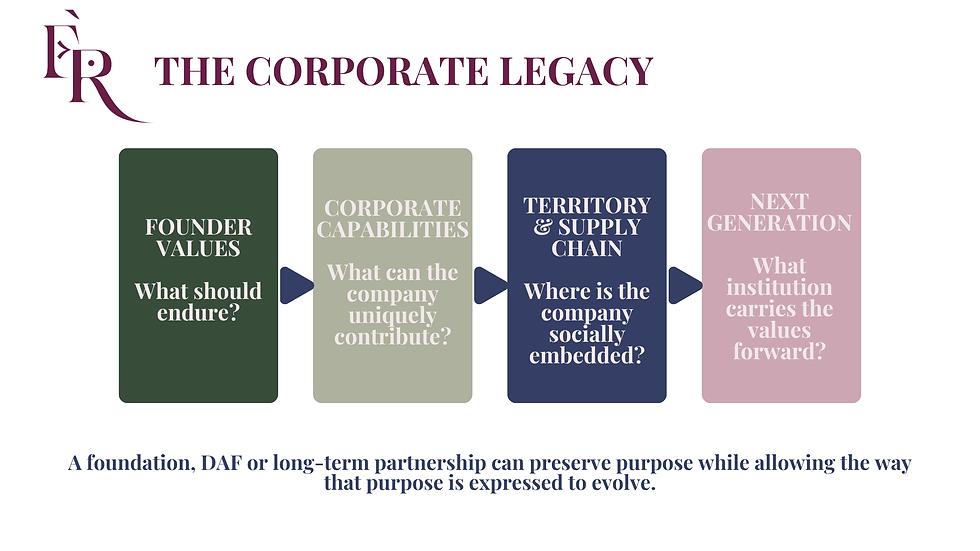
A foundation is not automatically a strategy
The growth of corporate foundations should not be confused with integration. Creating a separate entity can solve governance, continuity and focus problems, but it can also institutionalise fragmentation if the foundation operates without a clear relationship to the company's people, capabilities and wider social-investment portfolio.
The right level of alignment will differ by company. Independence can protect credibility and allow a foundation to pursue long-term social objectives beyond quarterly corporate priorities. Strategic connection can unlock expertise, employees, networks, data, procurement relationships and geographic reach. The governance task is to decide deliberately which assets should be shared, which decisions should remain independent and where reputational or operational boundaries are necessary.
This is particularly relevant for family-founded enterprises. Assifero notes that family foundations typically reflect values intended to pass from generation to generation. The corporate opportunity is to translate that intergenerational logic into an institutional architecture capable of surviving leadership change without freezing the founder's intentions into a static monument.
From sponsorship logic to investment logic
Integration also changes the relationship with the Third Sector. A company that views philanthropy primarily as sponsorship will naturally ask for visibility, audience and communication assets. A company that views it as strategic social investment will ask a different set of questions: What problem are we trying to address? What does the partner know that we do not? What capabilities can the company contribute beyond money? What outcome is realistic? What evidence will inform the next decision?
This does not eliminate communication. It makes communication downstream of substance. A credible programme should be communicable because something meaningful happened, not designed backwards from the content the company wants to publish.
For Italian companies with strong territorial identities, this shift can be especially powerful. Third Sector organisations provide proximity to communities and forms of 'social intelligence' that companies rarely possess internally. Research on cohesive enterprises in Italy similarly highlights the value of dialogue with the Third Sector for understanding social change and strengthening territorial relationships. The partnership therefore becomes a source of insight and capability, not simply a recipient of corporate generosity.
The management model: one portfolio, multiple forms of value
An integrated social-investment strategy does not require every programme to deliver every outcome. That would create artificial claims. It requires the portfolio to be explicit about the forms of value each intervention is expected to create.
A disability-employment programme may primarily target access to talent and employment outcomes. A foundation grant may primarily target community resilience. A skills-based volunteering programme may combine beneficiary capability with employee development. A territorial partnership may strengthen community outcomes and long-term legitimacy. A legacy initiative may preserve founder values and institutional identity. The portfolio becomes stronger when these objectives are differentiated, measured and then examined together.
For boards, this provides a more disciplined alternative to the usual choice between 'philanthropy as pure giving' and 'philanthropy as business case'. Strategic philanthropy does not need to instrumentalise every social investment. It does require management to understand why the company is investing, what value is expected for society and the organisation, and where the boundaries between those two forms of value should remain.

Italy's next frontier is integration
The Italian philanthropy ecosystem is already sophisticated enough to support the next step. It has family foundations, corporate foundations, community foundations, established Third Sector organisations, mechanisms such as the 5x1000, emerging donor-advised structures and a strong tradition of territorial relationships. The missing layer is often not another vehicle. It is the connective architecture.
That is the agenda Filantropì Renactimento and the ìMedici Institute of Strategic Philanthropy are developing in Italy: treating philanthropy, inclusion, employee participation, community relationships and selected people investments as parts of a Social Infrastructure portfolio, and then asking how that portfolio contributes to measurable social outcomes and to attraction, engagement, belonging and retention.
The 2027 executive platforms in Milan are designed around this management problem. The Talent & Purpose Strategy Lab in March will bring the workforce and social-investment conversations into the same room. The May Forum, Filantropia come Strategia, will widen the lens to philanthropy, corporate citizenship, Third Sector partnerships, impact and new institutional models. The objective is not to promote a single model, but to examine how companies can move from isolated good initiatives to coherent systems.
For Italy, that transition would be significant. It would preserve what is distinctive in the country's philanthropic tradition - family values, territorial relationships, civic participation and long-term stewardship - while connecting it to the strategic realities of the modern company.
The result is not philanthropy subordinated to HR or marketing. It is something more demanding: philanthropy recognised as part of the infrastructure through which a company expresses purpose, builds relationships and carries its values forward.
THE INTEGRATION QUESTION: If philanthropy, people strategy and corporate purpose all shape the cmpany's relationships, why are they still managed as separate systems?
Sources & reference framework
• Assifero, Family Foundations (accessed September 2026). Family foundations are described as the most common foundation type among Assifero membership; the organisation highlights the transmission of family values across generations.
• Assifero, Corporate Foundations (accessed September 2026). Assifero cites research identifying more than 150 corporate foundations in Italy and notes the absence of a single legal or strategic model.
• Osservatorio della Filantropia 2025 - Italia non profit. The 2025 research draws on information shared by more than 100 Italian foundations and examines operating models, beneficiary relationships, impact measurement and sector challenges.
• Italia non profit, Non Profit Data Hub - 5x1000 (2026). The Data Hub documents the continuing importance of the 5x1000 as part of Italy's philanthropic and Third Sector infrastructure.
• AICCON, 'A relational approach to the definition of social responsibility (the S of ESG)' (2022). Proposes an impact perspective connecting internal worker wellbeing and external community relationships.
• AICCON, 'BESt Work Life: a multidimensional approach to organisational climate measurement' (2024). Analysis of 790 responses across 26 organisations reports a positive relationship between worker participation and wellbeing.
• Fondazione Symbola / Intesa Sanpaolo / Unioncamere with AICCON and partners, 'Coesione è Competizione' (2024). Highlights links among collaboration, territorial embeddedness, employee satisfaction, customer dialogue and competitiveness.
• Filantropì Renactimento / ìMedici Institute of Strategic Philanthropy. Practitioner analysis and current work on Social Infrastructure, strategic philanthropy, corporate legacy, workforce outcomes and integrated social-investment governance in Italy.
--
EXPLORE THE SOCIAL INFRASTRUCTURE FRAMEWORK
What are your social investments actually building?
Our Social Infrastructure & Belonging Guide introduces a practical lens for examining how investments in people, communities and partnerships move from activity to lasting organisational and social value.
Use it to reflect on where your organisation is investing, what evidence is being collected, what outcomes those investments are producing, and what leadership should decide next.

--
AUTHOR

Dr. Giulia R. Tufaro is Managing Director of Filantropì Renactimento and Founder of the ìMedici Institute of Strategic Philanthropy.
Her work focuses on Social Infrastructure: the systems, relationships, capabilities and investment structures that enable people to belong, contribute and thrive — while giving organisations stronger evidence for executive decision-making.
She works with corporate leaders, institutions and ecosystem partners to connect investments across philanthropy, talent, inclusion, employee engagement, ESG and community partnerships; assess what those investments are actually building; and translate evidence into decisions about what to continue, scale, redesign or stop.
Her current work explores how Social Infrastructure can become a management discipline — helping organisations move beyond fragmented activity towards measurable outcomes, stronger organisational capability and long-term value.
Connect with her on LinkedIn: https://www.linkedin.com/in/dr-giulia-r-tufaro/
ABOUT FILANTROPÌ RENACTIMENTO
Filantropì Renactimento is a Social Infrastructure advisory and leadership platform working at the intersection of business, people, communities and long-term value.
We help organisations understand what their social investments are actually building. Our work connects initiatives that are often managed separately — across philanthropy, HR, ESG, DEI, Corporate Affairs, volunteering and nonprofit partnerships — and brings them into a common management framework.
--
DISCOVER MORE
For leadership teams that want to examine their own portfolio of social investments, Filantropì Renactimento offers executive diagnostics, strategic advisory and focused working sessions designed to connect evidence with decision-making.
CONTACT
Filantropì Renactimento
Via Ronche di Sopra n. 63, 31046 Oderzo (Treviso), Italy
IT: +39 347 859 8499


Comments